Most people don’t spend much time thinking about their shower door until it becomes a problem. The track fills with grime. The frame corrodes in the Florida humidity. The door sticks. Or maybe it’s just dated in a way that drags the whole bathroom down with it.
Choosing a shower door isn’t a minor finishing touch. It’s one of the most visible decisions in any shower upgrade, and it affects how the space looks, how easy it is to clean, and how long it holds up. Get it right, and it fades into the background in the best way possible. Get it wrong, and you’re reminded of it every morning.
This guide breaks down the three main styles (frameless, semi-frameless, and sliding) with honest trade-offs, a cost comparison, and a clear way to figure out which one actually fits your bathroom.
Key Takeaways
- Each shower door style suits a different set of priorities. There’s no universally “best” option, only the one that fits your space, budget, and cleaning tolerance.
- Frameless doors have the cleanest look and the fewest corrosion points, but they cost more and require precise installation.
- Semi-frameless doors offer a middle ground on both price and aesthetics, with less hardware than fully framed styles.
- Sliding doors solve space problems but introduce a track that needs consistent maintenance.
- In Florida’s humid climate, hardware finish and sealing quality matter more than most homeowners expect.
Why the Door Style Matters More Than It Looks?
A shower door is one of the few bathroom elements that gets touched every single day. It sees constant water exposure, steam, soap residue, and in Florida, the kind of persistent humidity that accelerates corrosion on anything metal.
The door style you choose affects four things: how the bathroom looks, how much floor space the door requires, how hard the enclosure is to clean, and how long the hardware holds up. Those four things should drive the decision, not just the photo you saved from a design blog.
The Three Main Shower Door Styles
Not every shower door works in every bathroom, and the differences between them go well beyond looks. Each style has a specific construction, a specific maintenance profile, and a specific set of conditions where it performs best. Here’s what you’re actually choosing between.
Frameless Shower Doors
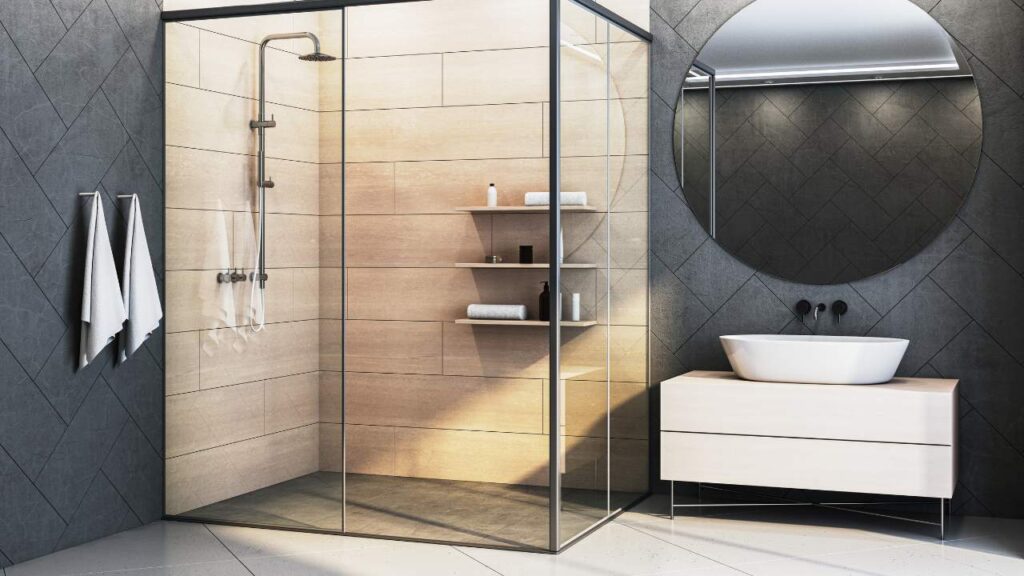
A frameless shower door uses thick tempered glass, typically 3/8 to 1/2 inch, with minimal metal hardware at the hinge and handle points. There’s no metal frame running along the edges of the glass panels.
The result is a very clean, open look. The glass becomes the focal point rather than the hardware around it. In smaller bathrooms, this visual openness can make the space feel considerably larger than it is. That’s not just an aesthetic opinion; removing the visual weight of a metal frame genuinely changes how a room reads.
From a maintenance standpoint, frameless enclosures have fewer seams, fewer metal edges, and fewer places for soap scum and mildew to accumulate. That said, the glass itself still needs regular cleaning. Hard water spots and soap film are the main ongoing issue, and in Florida, where water tends to be harder than average, this is something to plan around. A squeegee after each shower goes a long way.
The cost is the main barrier. Frameless enclosures sit at the higher end of the price range because of the glass thickness, precision of installation, and quality of hardware required. The hinges and handles on a frameless door carry a significant load, so the hardware grade matters considerably more than it does on a framed system.
Best for: Bathrooms with enough space for a swing door, homeowners who value a clean aesthetic and are prepared to maintain the glass, and upgrades where the shower is meant to be a focal point of the room.
Semi-Frameless Shower Doors
A semi-frameless shower door uses a frame along some edges but not all of them. The most common configuration is a fixed framed panel on one side, with a frameless or lightly framed swinging door. Some designs use a frame only along the top and sides of the enclosure, leaving the glass edges exposed.
The look sits somewhere between a fully framed door and a true frameless enclosure. It’s not as visually minimal as frameless, but it has considerably less hardware presence than a traditional framed system. For bathrooms where full frameless isn’t in the budget but a framed shower feels too dated, the semi-frameless shower door is often the most practical choice.
There’s also a durability argument. The partial frame gives the glass additional structural support, which can make the installation more forgiving if the walls aren’t perfectly square. Older homes, especially those built before the 1990s, often have walls that are slightly out of plumb. A frameless door requires much more precision at installation; a semi-frameless system has more flexibility built in.
Hardware maintenance is more involved than frameless but less than a sliding system. The metal frame components need occasional attention to prevent soap buildup and surface corrosion, particularly at the corner seals and bottom channel.
Best for: Mid-range budgets, bathrooms in older homes where walls may not be perfectly level, and homeowners who want a modern look without the full cost of frameless glass.
Sliding Shower Doors
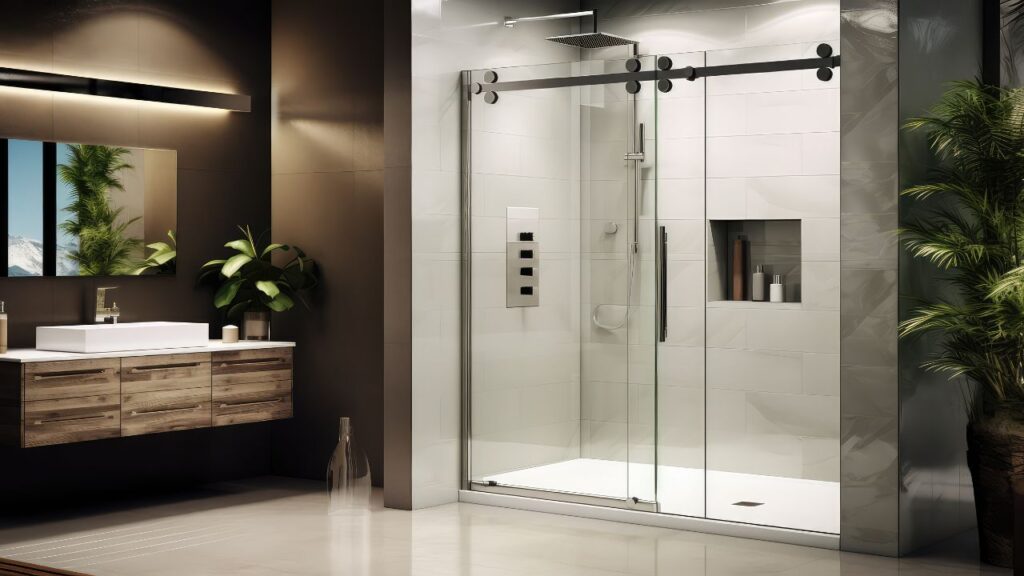
A sliding door (also called a bypass door) uses two or more glass panels that overlap and slide along a top and bottom track rather than swinging open. The panels move along a metal rail system mounted inside the shower opening.
The defining advantage is space. A swing door, whether frameless or semi-frameless, needs clearance to open. In a bathroom where the toilet, vanity, or opposite wall is close to the shower opening, a swing door creates a real usability problem. Sliding doors solve that entirely.
They’re also generally the most affordable option of the three, which makes them a reasonable choice for secondary bathrooms where budget matters more than visual impact.
The trade-off is the track. The bottom track on a sliding door collects water, soap residue, hair, and grime in a way that’s genuinely difficult to clean thoroughly. It’s not impossible to maintain, but it requires consistent attention. Neglected tracks are one of the most common sources of bathroom mold problems. The rollers and hardware also wear over time, and a sliding door that doesn’t glide smoothly is a daily annoyance.
Some newer sliding systems use a frameless glass design with minimal hardware and a cleaner track profile. These cost more but address some of the visual and maintenance drawbacks of traditional sliding systems.
Best for: Bathrooms with limited swing clearance, budget-conscious upgrades, and alcove shower configurations where a bypass door fits naturally.
Side-by-Side Comparison
| Factor | Frameless | Semi-Frameless | Sliding |
| Visual style | Most open and minimal | Modern with some hardware presence | Traditional to contemporary depending on glass choice |
| Glass thickness | 3/8″ to 1/2″ tempered | 1/4″ to 3/8″ tempered | 3/16″ to 1/4″ tempered |
| Space requirement | Needs clearance for swing | Needs clearance for swing | No swing clearance needed |
| Cleaning effort | Moderate (glass only) | Moderate (glass + partial frame) | Higher (track and rollers) |
| Hardware corrosion risk | Low (minimal metal) | Medium (partial frame edges) | Higher (track system) |
| Installation precision needed | High | Moderate | Lower |
| Typical cost range | $900 to $3,000+ installed | $500 to $1,500 installed | $300 to $1,000 installed |
| Best bathroom size | Medium to large | Any | Small to medium |
| Long-term durability | Excellent with proper hardware | Very good | Good with regular maintenance |
What Actually Drives the Decision
Style preference is a real factor, but it’s usually not the first one that should shape the choice. Layout constraints, maintenance habits, and the conditions specific to your home tend to narrow the options before aesthetics even come into play. These are the practical factors worth working through before you commit.
Your bathroom layout comes first
Before style or budget, figure out whether a swing door is even viable. Measure the distance from the shower opening to the nearest obstruction, whether that’s the toilet, vanity, or opposite wall. Most swing doors need at least 24 to 30 inches of clearance to open comfortably. If you don’t have it, the choice between frameless and semi-frameless becomes secondary. A sliding door is the practical answer.
The wall system behind the door matters
A shower door doesn’t work in isolation. It meets the wall at the edges, and the quality of that connection affects how well the enclosure holds up over time. If the surrounding walls are solid surface panels, the door installation tends to be cleaner and the seal more reliable than it is against tile with grout lines. American Bath & Shower’s solid surface wall systems are designed for exactly this kind of clean, consistent interface. It’s worth thinking about the full enclosure, not just the door.
Florida humidity changes the hardware equation
This is specific to where you live. Humid climates accelerate corrosion of metal hardware, especially finishes like chrome or standard brushed nickel, in poorly ventilated bathrooms. Frameless systems have the least metal exposure, which is part of why they hold up well long-term. If you’re choosing a semi-frameless or sliding system, the finish quality and coating of the hardware are worth asking about directly. Oil-rubbed bronze and matte black finishes tend to show water spots less obviously than polished chrome in high-humidity environments.
Cleaning tolerance is a real factor
People underestimate how much they’ll dislike cleaning a particular door style until they’re already living with it. If you know you won’t get into the corners of a sliding track regularly, that’s not a moral failing. It’s just information. Choose a door system that matches your actual cleaning habits, not your aspirational ones. A frameless door with a squeegee routine is genuinely low-maintenance. A sliding door that goes weeks without track cleaning is a different story.
Pairing Your Door with the Right Fixtures
The door style you choose should coordinate with the hardware finish across the rest of the shower. Handles, hinges, showerhead, and hand shower brackets all carry their own finish, and a mismatched set makes even an expensive door look like an afterthought.
According to the NKBA’s own design guidance, sticking to metals with similar finishes across a bathroom (all polished or all matte, rather than a mix of both) is one of the most reliable ways to make a space feel intentionally designed rather than pieced together. The fixtures and accessories at American Bath & Shower are selected to work cohesively with the shower systems they offer. If you’re upgrading the door as part of a broader shower renovation, getting the finish coordinated from the start is considerably easier than retrofitting it later.
Glass Safety: What the Standards Actually Say?
This doesn’t come up in most door conversations, but it should. All shower enclosure glass in Florida must be tempered or laminated safety glass under the Florida Building Code, which aligns with the broader requirements in the International Building Code. Tempered glass, when it does break, fractures into small, blunt pieces rather than large, sharp shards.
Building codes in the U.S. require safety glazing in all shower enclosures. The International Residential Code, published by the International Code Council, spells this out directly: IRC Section R308.4.5 classifies shower and tub enclosures as hazardous locations requiring safety glazing that meets CPSC or ANSI impact standards. Tempered glass satisfies this by shattering into small, blunt fragments rather than sharp shards if broken. That’s the point. But the glass only performs that way when it’s properly installed. A frameless door with compromised edge seating or incorrect hardware torque is a safety risk regardless of how good the glass is.
When you’re comparing quotes for any shower door installation, asking about glass certification and edge finishing is reasonable. Any reputable installer should be able to answer without hesitation.
A Simple Decision Framework
If you’re still unsure which direction to go, work through these three questions in order.
- Do you have swing clearance? If not, a sliding door is the practical answer. Stop there. If yes, continue.
- What’s the budget for this part of the project? If you have flexibility and want the cleanest possible look, frameless is worth the investment. If budget is a real constraint, semi-frameless delivers a genuinely modern result at a lower price point.
- How much time will you put into cleaning the door? If the honest answer is “not much,” lean toward frameless or semi-frameless over a sliding track. Both are easier to maintain consistently.
FAQs
Does a frameless shower door require any special installation conditions?
Yes. Frameless installations require plumb walls and a level floor. The hardware is load-bearing in a way that framed systems aren’t, so the surrounding structure needs to be sound. Your installer should assess this during the planning stage.
Are sliding shower doors less waterproof than swing doors?
They can be, particularly around the track area and where the panels overlap. A well-installed sliding door with quality seals performs fine, but the track does create more potential gaps than a sealed swing door. Proper installation and consistent maintenance address this.
Can I use a frameless door on a tub-to-shower conversion?
In most cases, yes, depending on the configuration of the shower opening. Frameless doors can be installed on alcove conversions as well as three-wall configurations. The key is having adequate wall support for the hinge mounting points.
How long do frameless shower doors typically last?
With quality hardware and proper installation, frameless glass enclosures can last 20 to 30 years. The glass itself rarely fails; the hardware and seals are more likely to need attention over time. This is why hardware grade matters at purchase, not just the glass.
What’s the best door style for a small master bath in a Florida home?
If space allows for a swing door, a semi-frameless enclosure tends to offer the best value in that context: a modern look, reasonable price, and hardware that holds up in humid conditions when the finish is chosen carefully. If the space is tight, a frameless sliding system with a minimal track profile is worth looking at.
Getting the Choice Right the First Time
A shower door is one of those decisions that feels minor until you’re cleaning around the wrong hardware every week or dealing with a swing door that clips the toilet every morning. The right choice is quiet and practical. You stop noticing it.
The shower solutions team at American Bath & Shower can walk you through door options as part of a full shower assessment, including how the door style works with your wall system, layout, and fixture selection.Schedule a free consultation and get a clear recommendation for your specific bathroom, not a generic one.