You’ve selected the perfect tile, found the right vanity, and chosen a color palette that makes the space feel exactly how you want it to feel. Then you start shopping for faucets, shower fixtures, and hardware, and the decisions multiply. Chrome or brushed nickel? Should the towel bar match the faucet exactly? What about the cabinet pulls? Can you mix finishes, or does everything need to be identical?
These aren’t trivial questions. Fixture and hardware finishes create visual continuity in a bathroom, and when they’re coordinated well, the space feels intentional and complete. When they’re not, the room can look like it was assembled from leftover parts. This blog walks through the practical strategies designers use to create cohesive bathroom aesthetics through thoughtful fixture coordination.
Key Takeaways
- The 70/30 rule provides a professional framework: use one dominant finish for 70-80% of fixtures and a complementary accent finish for the remaining 20-30%.
- Fixtures within the same functional zone (shower area, vanity area) should always share the same finish to maintain visual unity.
- Matching means identical finishes; coordinating means complementary finishes that work together, and both approaches can create successful bathroom designs.
- Style consistency matters as much as finish matching: modern fixtures should not be paired with ornate traditional hardware, regardless of finish compatibility.
- The National Kitchen and Bath Association recommends establishing a unified design vision before selecting individual fixtures to ensure cohesive results.
The Difference Between Matching and Coordinating
Before getting into specific strategies, it’s worth clarifying what these terms actually mean in bathroom design.
Matching refers to using identical finishes across all fixtures and hardware. Every faucet, showerhead, towel bar, cabinet pull, and toilet paper holder shares the same finish. This creates a uniform look with minimal visual interruption. It’s the safest approach and the one most commonly seen in standard builder-grade bathrooms.
Coordinating involves selecting finishes that complement each other without being identical. You might pair brushed nickel faucets with matte black cabinet hardware, or combine polished chrome plumbing fixtures with oil-rubbed bronze towel bars. This approach adds depth and visual interest but requires more deliberate planning to execute successfully.
Both strategies work. The right choice depends on your design goals, the bathroom’s size, and your comfort level with making finish selections. Matching simplifies the decision-making process and guarantees a clean result. Coordinating offers more creative flexibility but increases the risk of a disjointed outcome if not done thoughtfully.
The 70/30 Rule for Mixing Finishes
If you decide to coordinate rather than match, professional designers often follow what’s known as the 70/30 rule. This guideline, referenced by design professionals, provides a structured approach to mixing finishes without creating visual chaos.
Here’s how it works: select one dominant finish for 70 to 80 percent of the bathroom’s metal fixtures. This becomes your primary finish and should be used on the largest, most visually significant items like the main faucet, shower trim, and primary lighting fixtures.
The remaining 20 to 30 percent of fixtures use a complementary accent finish. This secondary finish appears on smaller elements such as cabinet pulls, towel rings, toilet paper holders, and decorative hardware.
The proportional distribution is what makes this approach effective. The dominant finish establishes visual continuity across the space, while the accent finish adds contrast and interest without overwhelming the design. When the proportions are reversed or when too many finishes are introduced, the bathroom starts to feel cluttered and uncoordinated.
Zone-Based Coordination: Keeping Functional Areas Unified
Even when mixing finishes, certain fixtures should always match within their functional zones. This principle is essential for maintaining visual coherence.
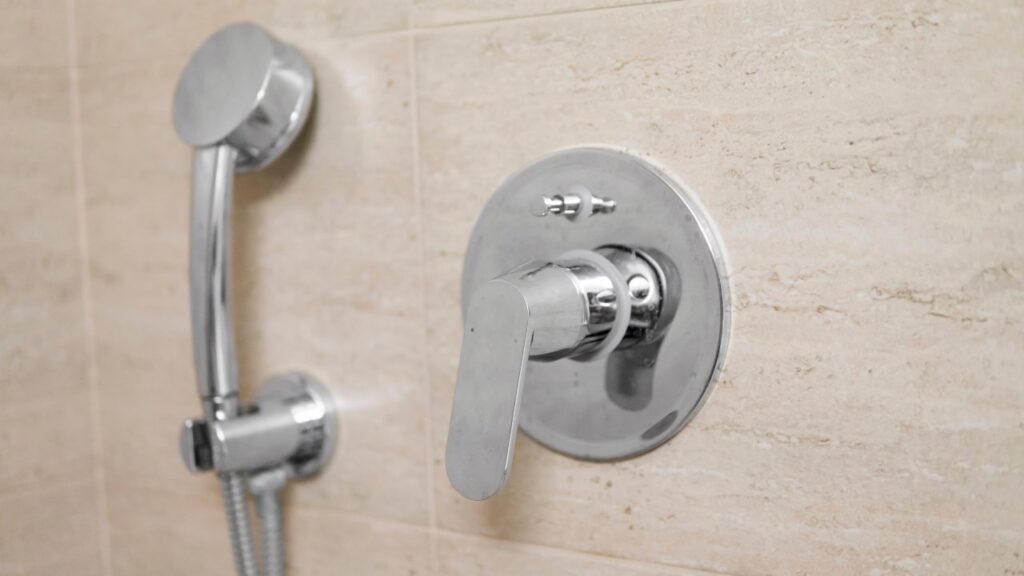
The shower zone includes the showerhead, shower trim (the visible valve and handle assembly), tub spout if applicable, and hand shower. All of these components should share the same finish. They’re in close proximity, they’re used together as part of the same system, and they’re often viewed simultaneously. Mixing finishes within this zone breaks the visual unity of what should be a cohesive fixture group.
The vanity zone includes the faucet, drain assembly, and any fixture-mounted accessories. These should match. If you have a double vanity, both faucets need to be identical in finish and style.
The hardware zone encompasses towel bars, toilet paper holders, robe hooks, and cabinet pulls. These can differ from the plumbing fixtures, but they should match each other to create a secondary visual layer throughout the room.
This zone-based approach allows you to mix finishes across functional areas while maintaining order within each zone. For example, you might use brushed nickel in the shower and vanity zones while using matte black for all hardware. The zones remain internally consistent even as the overall room incorporates two finishes.
Balancing Warm and Cool Tones
When coordinating finishes, the relationship between warm and cool metal tones matters more than most people realize.
Warm finishes include brass, gold, bronze, and copper tones. These finishes have yellow, red, or brown undertones that add warmth to the space.
Cool finishes include chrome, polished nickel, stainless steel, and most brushed nickel options. These have blue, gray, or silver undertones that create a cleaner, more modern feel.
Neutral finishes like matte black, matte white, and some oil-rubbed bronzes can work with either warm or cool palettes, making them versatile choices for accent finishes.
The general principle is to avoid mixing warm and cool finishes in equal proportions. If your dominant finish is warm brass, your accent finish should either be another warm tone (like oil-rubbed bronze) or a neutral (like matte black). Introducing a cool-toned chrome accent would create temperature conflict that feels visually uncomfortable.
The exception to this guideline is when you’re deliberately using temperature contrast as a design statement, which works best in larger bathrooms where the finishes can be spatially separated enough to read as intentional rather than accidental.
Style Consistency: The Overlooked Factor
Finish coordination gets most of the attention in fixture selection conversations, but style consistency is equally important. A fixture’s style encompasses its shape, profile, detailing, and overall design language.
- Modern fixtures feature clean lines, geometric shapes, minimal ornamentation, and streamlined profiles. Think square edges, cylindrical forms, and unembellished surfaces.
- Traditional fixtures incorporate curves, decorative details, ornate elements, and classical proportions. These often include fluted handles, scrollwork, or vintage-inspired silhouettes.
- Transitional fixtures blend elements of both modern and traditional design, creating a balanced middle ground that works in a variety of settings.
Mixing styles is where many bathroom designs fail, even when the finishes are perfectly coordinated. A sleek, angular modern faucet paired with an ornate, curved Victorian-style towel bar creates visual discord regardless of whether both are brushed nickel. The finishes match, but the style language doesn’t, and the result feels unintentional.
When selecting fixtures, pay as much attention to profile and form as you do to finish. If your primary faucet has sharp, linear edges, your hardware should follow similar geometric principles. If your shower fixtures feature soft curves and rounded forms, your accessories should echo that softness.
Practical Finish Pairing Strategies
Certain finish combinations have proven track records for creating cohesive bathroom designs. Here are pairing strategies that work reliably:
Monochromatic approach: Use variations of the same finish family. For example, pair brushed nickel fixtures with satin nickel hardware, or combine polished chrome plumbing with brushed chrome accessories. The slight variation adds subtle texture while maintaining overall unity.
Neutral accent strategy: Use a dominant metallic finish for plumbing fixtures and introduce matte black or matte white for hardware. The neutral accent provides contrast without temperature conflict.
Warm-on-warm pairing: Combine warm finishes like brushed gold faucets with oil-rubbed bronze hardware. Both share warm undertones, creating a layered metallic look without temperature clash.
Statement contrast: In larger bathrooms, use bold contrast like matte black fixtures with brass hardware. This works when the finishes are spatially distributed across distinct zones rather than clustered together.
The Role of Permanent Elements
Your fixture selections don’t exist in isolation. They need to coordinate with the permanent elements already in the space: tile, countertops, cabinetry, and wall colors.
Tile selection often determines which fixture finishes will work. Cool gray tile naturally pairs with chrome or brushed nickel, while warm beige or travertine tile complements brass or bronze finishes. Fighting against your tile’s undertones creates additional coordination challenges.
Countertop materials have undertones too. White marble with gray veining suggests cool finishes, while cream-colored quartz or granite with warm veining works better with gold or brass tones.
Cabinet finishes create another coordination point. Dark wood cabinets pair well with warm metal finishes, while white or light gray cabinets offer more flexibility and work with both warm and cool fixture finishes.
The National Kitchen and Bath Association emphasizes that successful bathroom design requires considering how all elements work together from the planning stage, not treating each selection as an independent decision.
A Finish Coordination Framework
Here’s a comparison of common finish pairings and when each works best:
| Dominant Finish | Recommended Accent Finish | Best For | Avoid Pairing With |
| Polished Chrome | Matte Black | Modern bathrooms | Brass, Oil-rubbed Bronze |
| Brushed Nickel | Matte Black or Satin Nickel | Transitional spaces | Polished Gold |
| Matte Black | Brushed Gold or Brass | Contemporary designs | Polished Chrome |
| Brushed Gold | Oil-rubbed Bronze | Traditional bathrooms | Chrome, Stainless Steel |
| Oil-rubbed Bronze | Aged Brass | Rustic or traditional | Polished Chrome, Bright Nickel |
| Stainless Steel | Matte White or Chrome | Modern, minimalist | Warm brass tones |
This table provides starting points, not absolute rules. Your bathroom’s specific context, size, lighting, and existing finishes all influence which combinations will work best.
Common Coordination Mistakes to Avoid
Even with good intentions, certain mistakes appear frequently in bathroom fixture selection:
- Using too many finishes. Three different metal finishes in a single bathroom is the maximum, and that only works in larger spaces. Small bathrooms should stick to a maximum of two finishes, or ideally one.
- Mixing finishes within the shower or vanity zone. These functional groupings should always be internally consistent. Don’t put a chrome faucet next to brass cabinet pulls on the same vanity.
- Ignoring style consistency while focusing only on finish. A modern, square-edged faucet and a traditional, ornate towel bar will clash, even if both are brushed nickel.
- Selecting fixtures without considering lighting. Warm lighting enhances brass and gold finishes but can make chrome look yellow. Cool lighting complements chrome and nickel but can make brass appear dull.
- Making selections in isolation. Choosing the perfect faucet without considering what shower trim, hardware, or accessories will complement it leads to coordination problems later.
Making the Final Decision
The most successful bathroom designs start with a clear plan before any individual pieces are chosen. Begin by defining your overall style, whether that is modern, traditional, or transitional, since that will guide which fixture shapes and details make sense. From there, choose your dominant finish for the most visible elements, such as the faucet, shower trim, and main lighting, then add an accent finish only if it complements the primary one and stays balanced within the space.
Before finalizing anything, compare your selections side by side to make sure the lines, profiles, and overall feel are consistent, and always check that your fixture choices work naturally with permanent elements like tile, countertops, and cabinetry.
If you’re planning a bathroom remodel and want guidance on creating a cohesive fixture palette that works with your specific space, American Bath & Shower’s fixtures and accessories expertise includes helping homeowners navigate these decisions. An in-home consultation allows you to see how different finishes will actually look in your lighting and with your existing materials.
FAQ
Should all bathroom fixtures match exactly?
Not necessarily. Matching creates a safe, cohesive look, but coordinating complementary finishes can add visual interest. The key is intentional selection rather than random mixing.
Can I mix chrome and brushed nickel in the same bathroom?
It’s generally not recommended. Chrome and brushed nickel are both cool-toned but have different levels of shine, which creates visual confusion rather than intentional coordination. If you want a subtle variation within the cool-toned family, consider pairing brushed nickel with satin nickel instead.
What’s the best finish for a small bathroom?
Smaller bathrooms benefit from a single finish throughout. This creates visual continuity, making the space feel larger and more cohesive. Chrome, brushed nickel, or matte black are all excellent single-finish choices.
How many metal finishes can I use in one bathroom?
Two finishes work well in most bathrooms using the 70/30 distribution. Three finishes can work in larger bathrooms but should be used carefully, with one dominant finish (60-70%), one secondary accent (20-30%), and one small accent (5-10%).
Do cabinet pulls need to match the faucet?
They don’t need to match exactly, but they should coordinate. Cabinet pulls and other hardware are good candidates for an accent finish if you’re using the 70/30 approach, while the faucet should use the dominant finish.
Can I mix matte black fixtures with brass hardware?
Yes. Matte black is a neutral finish that pairs well with warm brass tones. This combination works particularly well in modern or contemporary bathrooms where the contrast creates visual interest without temperature conflict.
Should shower trim and the faucet always be the same finish?
Yes, if they’re in the same bathroom. Visible plumbing fixtures should share a unified finish to maintain cohesion. The shower area is a functional zone that should be internally consistent.